

For years, content teams optimized primarily for one outcome: ranking in search results.
That meant researching keywords, publishing blogs, improving on-page SEO, and trying to earn clicks from Google.
That model still matters, but it is no longer enough.
Customers now discover information across Google, AI Overviews, ChatGPT, Perplexity, Gemini, Copilot, and other AI-assisted search experiences. They are asking longer questions, requesting comparisons, and expecting direct answers instead of opening ten separate pages.
This changes what businesses should expect from content writing and strategy services.
The goal is no longer simply to create content that ranks. It is to create content that search engines can find, AI systems can retrieve and cite, and customers can trust enough to act on.
Search Visibility Is No Longer Just About Rankings
Traditional SEO focused on familiar metrics such as rankings, impressions, clicks, traffic, and conversions.
AI search adds another layer.
Content can now influence a customer even when there is no immediate website visit. A page may be cited in an AI-generated response, used in a comparison, or help an AI system understand what a company does.
This means content marketing services need to think beyond SERP positions.
Content should be designed to support visibility across multiple discovery environments while still driving meaningful business outcomes.
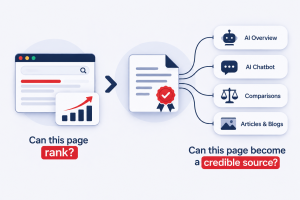
The question is no longer only:
“Can this page rank?”
It is also:
“Can this page become a credible source?”
AI Has Made Average Content Easier to Produce
Generative AI has dramatically reduced the time required to produce content.
That has also made generic content far less valuable.
If an article says essentially the same thing as hundreds of other pages, there is little reason for a search engine, AI platform, or customer to prioritize it.
This changes the role of professional content writing services.
Writers now need to bring something beyond competent explanations.
That could include:
- first-hand experience,
- original data,
- subject-matter expertise,
- customer insights,
- case studies,
- practical examples,
- technical knowledge,
- or a distinctive industry perspective.
The strongest content is increasingly the content that cannot be recreated simply by summarizing what already exists online.
SEO Content Creation Needs to Go Beyond Keywords
Keywords still matter because they reveal demand and customer language.
But a keyword should not become the entire content strategy.
A user may search Google for:
“CRM software for small business.”
But ask an AI assistant:
“Which CRM is best for a 20-person consulting firm that needs Microsoft 365 integration, simple reporting, and no dedicated administrator?”
The second query carries much more context.
Good SEO content creation therefore needs to address the full decision around a topic.
That means answering questions such as:
- Who is this solution best suited for?
- What are the limitations?
- What alternatives exist?
- What does implementation involve?
- What should customers compare?
- What mistakes should they avoid?
Content becomes more valuable when it helps users move from discovery to evaluation and decision-making.
Strategy Should Come Before the Content Calendar
Many businesses still begin content planning by deciding how many blogs to publish every month.
A better approach is to first define what the content needs to achieve.
A content strategy agency might build content around objectives such as:
- capturing high-intent search demand,
- improving AI search visibility,
- building category authority,
- educating prospective customers,
- supporting sales conversations,
- or generating qualified leads.
Only after the objective is clear should the publishing calendar be created.
This prevents brands from producing content simply to maintain volume.
The better question is:
Which customer questions and decisions should this brand be visible for?
From there, content can be organized around topics, buyer stages, use cases, comparisons, and high-value search intent.
Structure Matters More in AI Search
Content structure has always mattered for readability.

Now it matters for retrieval too.
AI systems need to identify what information exists on a page and how individual sections relate to a user’s question.
That makes clear organization increasingly important.
Effective content often includes:
- descriptive headings,
- direct answers,
- concise definitions,
- comparison tables,
- FAQs,
- examples,
- processes,
- and evidence-backed claims.
This does not mean every article should become a collection of short answers.
It means important information should not be buried inside unnecessary filler.
Clarity helps both users and machines.
SEO Blog Writing Needs More Subject-Matter Expertise
Basic informational content is becoming easier to automate.
That means professional SEO blog writing services need to offer something more valuable than a rewritten summary of existing search results.
Subject-matter input becomes critical.
- An engineer may explain why a common implementation approach fails.
- A sales team may know which objections repeatedly appear during enterprise deals.
- A customer-success team may understand what causes users to struggle after purchase.
- A founder may have a market perspective competitors are not discussing.
The content writer’s role is to extract, structure, and communicate those insights.
That is far more valuable than simply producing another optimized article.
Content Needs to Support More of the Buyer Journey
Many content programs still concentrate heavily on awareness-stage topics such as:
“What is X?”
“How does Y work?”
“What are the benefits of Z?”
Those topics can still perform well, but AI systems can increasingly answer basic questions directly.
Businesses therefore need stronger middle- and bottom-funnel content.
For businesses investing in paid acquisition, understanding how AI is changing PPC and paid advertising can also help them adapt campaign strategies to evolving customer behavior and decision-making.
This can include comparison pages, buying guides, case studies, implementation content, industry-specific use cases, pricing explainers, alternatives pages, and detailed FAQs.
These assets help customers make decisions rather than simply learn definitions.
They also give AI systems more useful evidence when users ask comparison or recommendation questions.
Brand Authority Is Becoming Part of Content Strategy
AI search does not rely exclusively on information published on a company’s website.
Search systems can pull information from industry publications, reviews, forums, third-party articles, directories, and other credible sources.
That means content strategy increasingly overlaps with brand authority.
A company cannot simply publish ten articles calling itself an expert and expect the wider web to confirm that claim.
Independent validation matters.
Thought leadership, customer reviews, expert commentary, digital PR, research mentions, and reputable third-party coverage can all strengthen how a brand is understood online.
Content strategy should therefore consider both owned content and the wider information environment surrounding the company.
The Future of Content Is Not More Content
AI has made publishing faster.
That does not mean businesses should publish more for the sake of volume.
The competitive advantage is moving toward originality, clarity, authority, and usefulness.
Strong content still needs to perform in search.
But it also needs to be understandable enough for AI systems to retrieve, credible enough to be cited, and useful enough to influence the customer once they reach it.
That is why modern content writing and strategy services should combine SEO, customer intent, subject-matter expertise, editorial quality, AI-search considerations, and business strategy.
The future is not about filling content calendars.
It is about creating information assets that deserve to be found.
And in the AI search era, that distinction matters more than ever.