

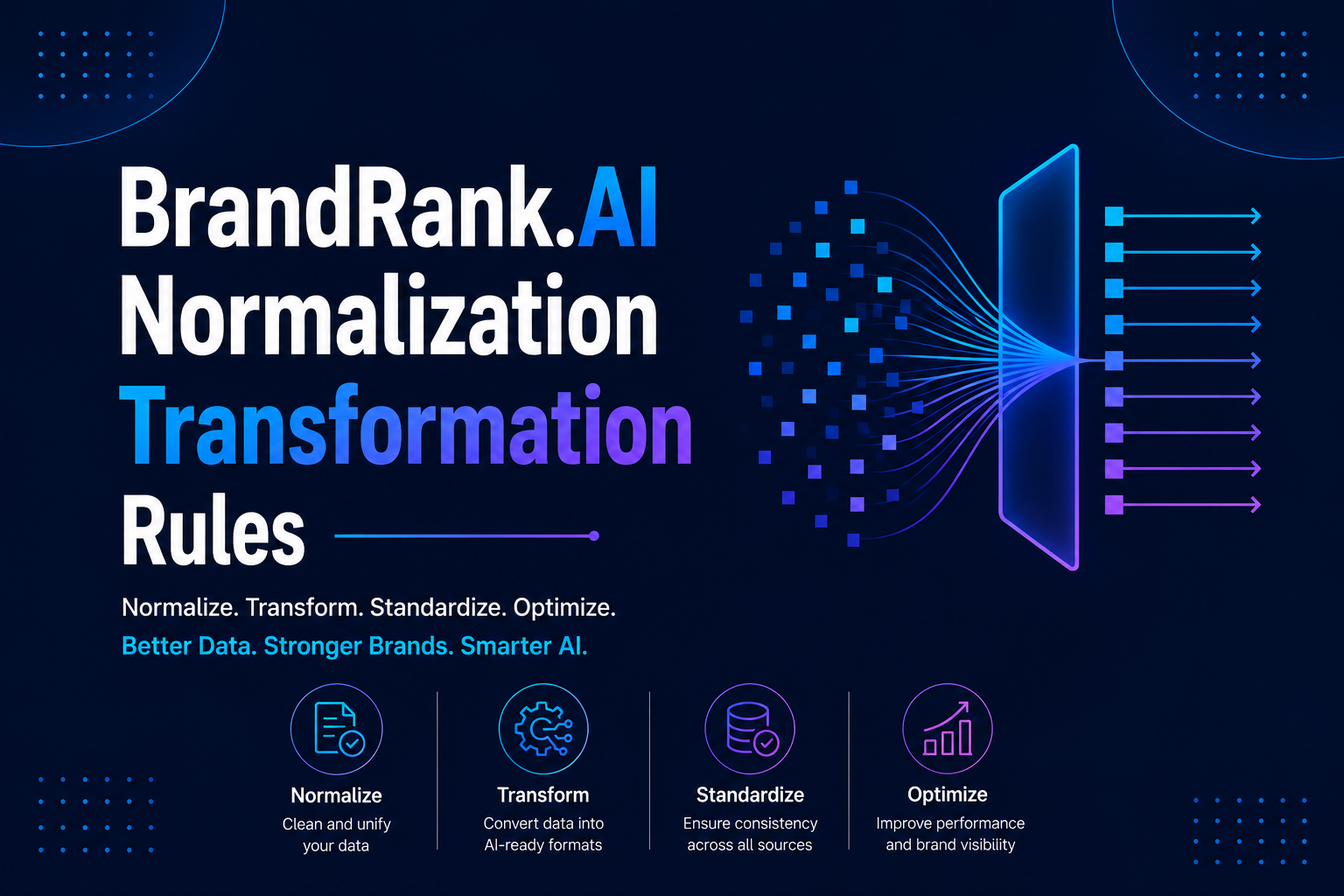
Introduction
Artificial intelligence is rapidly changing how people discover brands online. Instead of relying only on traditional search engine rankings, AI assistants now analyze information from websites, business directories, social platforms, news publications, and structured data to determine whether a brand is trustworthy and relevant.
As AI-powered search becomes more sophisticated, maintaining consistent brand information across every digital touchpoint has become increasingly important. This has led many marketers and SEO professionals to discuss brandrank.ai normalization transformation rules as a practical approach to improving brand consistency for AI-driven search experiences.
It is important to understand that there is currently no publicly available official technical specification published under this exact name. Rather, the phrase is commonly used to describe a collection of best practices that help AI systems recognize a business as a single, reliable entity across the web.
This article explores the underlying concepts, why they matter, and how organizations can implement them to strengthen their digital presence.
The Evolution of Search Beyond Keywords
Traditional SEO focused heavily on keywords, backlinks, and page optimization. While these factors remain valuable, AI search systems evaluate information differently.
Modern AI models attempt to understand:
- Organizations
- Products
- People
- Relationships
- Context
- Authority
- Trustworthiness
Instead of simply ranking pages, AI attempts to identify entities and determine whether multiple references point to the same organization.
This shift means businesses must think beyond individual webpages and focus on building a unified digital identity.
Understanding Data Normalization
Normalization is the process of converting inconsistent information into a standardized format.
Businesses often create inconsistency without realizing it.
Examples include:
- Multiple versions of the company name
- Different logo variations
- Old business addresses
- Mixed phone number formats
- Different capitalization
- Inconsistent social media profiles
Although people easily recognize these as referring to the same organization, AI systems may interpret them as separate entities.
Normalization removes these inconsistencies by selecting one preferred format and using it consistently.
What Is Data Transformation?
Transformation follows normalization.
Once information has been cleaned and standardized, it is converted into formats that software systems and AI models can process more efficiently.
Transformation may include:
- Structured data markup
- JSON-LD implementation
- Schema markup
- Metadata optimization
- Standardized product feeds
- Machine-readable business information
Rather than changing the meaning of data, transformation improves its structure and usability.
Why AI Systems Need Consistent Brand Information
Large language models gather information from numerous sources.
These sources may include:
- Official websites
- Business directories
- Government databases
- News websites
- Review platforms
- Social media
- Knowledge graphs
When all these sources provide consistent information, confidence increases that they describe the same organization.
Inconsistent data, however, creates uncertainty.
This uncertainty can reduce the likelihood of accurate recognition within AI-generated answers.
The Role of Entity Recognition
Entity recognition allows AI to distinguish organizations from ordinary text.
Instead of viewing a company name as merely a collection of words, AI identifies it as a real-world entity connected with products, services, locations, founders, industries, and online references.
The stronger these relationships become, the easier it becomes for AI systems to understand the organization accurately.
Why Consistency Matters Across Digital Channels
Every online platform contributes signals.
Examples include:
Official Website
Your website should consistently display:
- Business name
- Logo
- Contact information
- About page
- Privacy policy
- Structured data
Business Listings
Directories should contain identical information.
Avoid:
- Different abbreviations
- Outdated addresses
- Old phone numbers
Social Profiles
Maintain consistency in:
- Usernames
- Brand descriptions
- Logos
- Website URLs
- Contact details
News Mentions
Press coverage should reference the official business name whenever possible.
Technical Elements That Strengthen AI Understanding
Several technical SEO practices contribute to clearer entity recognition.
Structured Data
Schema markup provides explicit information about:
- Organization
- Products
- Services
- Authors
- Reviews
- Articles
Structured data helps search systems interpret content more accurately.
Canonical URLs
Canonical tags reduce duplicate content confusion by identifying the preferred version of each page.
Consistent Metadata
Title tags, descriptions, Open Graph tags, and structured metadata should accurately reflect official branding.
Internal Linking
Logical internal links help AI understand website hierarchy and relationships between pages.
Content Quality Remains Essential
Technical optimization alone cannot establish authority.
Content should demonstrate:
- Original research
- Expert insights
- Practical experience
- Accurate references
- Helpful explanations
AI systems increasingly evaluate information quality rather than simply counting keywords.
EEAT and AI Visibility
Google emphasizes four major quality principles:
Experience
Content should reflect real-world knowledge.
Expertise
Articles should demonstrate subject expertise.
Authoritativeness
Brands should earn recognition from trustworthy sources.
Trustworthiness
Websites should provide transparent, accurate, and reliable information.
These principles align closely with how AI systems evaluate trustworthy entities.
Common Mistakes Businesses Make
Many organizations unknowingly weaken their online identity.
Typical issues include:
- Multiple business names
- Old branding still indexed
- Different logos across platforms
- Duplicate social accounts
- Broken structured data
- Missing author information
- Inconsistent contact details
- Mixed HTTPS and HTTP references
Correcting these issues improves overall data quality.
Practical Steps for Businesses
Organizations can strengthen their digital identity through a structured process.
Audit all online mentions
Review every location where the business appears.
Standardize business information
Use one official version consistently.
Update outdated listings
Remove obsolete addresses and contact information.
Improve structured data
Implement Organization, Website, Article, and Person schema where appropriate.
Create authoritative content
Publish useful, well-researched resources regularly.
Build trusted citations
Earn mentions from reputable publications and industry sources.
Monitor brand consistency
Regularly review online information for inaccuracies.
The Future of AI Search
AI-powered search continues to evolve rapidly.
Rather than simply indexing pages, future systems are expected to become even better at understanding entities, relationships, context, and trust.
Businesses that maintain consistent, structured, and authoritative digital identities will likely be better positioned for accurate recognition across AI-powered search experiences. Discussions around brandrank.ai normalization transformation rules reflect this broader shift toward entity consistency and AI readiness, even though the phrase does not refer to an official published standard.
Conclusion
Artificial intelligence is changing how brands are discovered online. Success increasingly depends on presenting a clear, consistent, and trustworthy digital identity rather than relying solely on traditional keyword optimization.
The concepts commonly described as brandrank.ai normalization transformation rules encourage organizations to standardize information, strengthen technical implementation, improve structured data, and build authoritative content. When combined with Google’s EEAT principles, these practices can improve how AI systems understand and represent a brand across the web.
Frequently Asked Questions
What are brandrank.ai normalization transformation rules?
The term is commonly used to describe best practices for standardizing brand information across digital platforms so AI systems can recognize an organization consistently. It is not currently an officially published technical specification.
Why is brand consistency important for AI search?
Consistent business information helps AI models connect data from multiple sources, improving confidence that all references belong to the same organization.
How does EEAT support AI visibility?
EEAT encourages websites to publish trustworthy, expert, and experience-based content, making it easier for search engines and AI systems to evaluate credibility.
Does structured data improve AI understanding?
Yes. Structured data provides machine-readable information that helps search systems identify organizations, products, authors, and other entities more accurately.
Can traditional SEO still help?
Absolutely. Strong technical SEO, quality content, fast website performance, and authoritative backlinks remain valuable while supporting AI-driven discovery.
How often should businesses review their online information?
A complete audit every few months is recommended, with immediate updates whenever business details, branding, products, or contact information change.